New Publication: "Authenticity in Computational Writing"
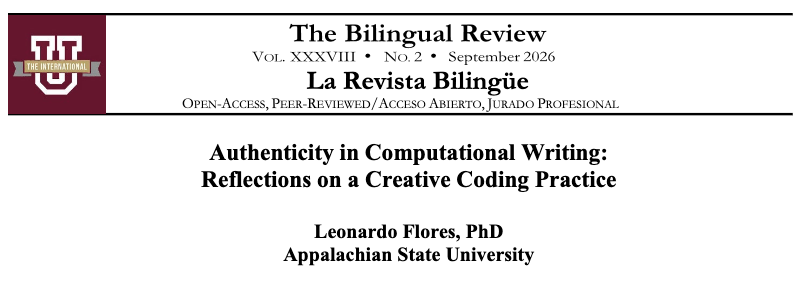
I am pleased to share my article “Authenticity in Computational Writing: Reflections on a Creative Coding Practice” which was published in a special issue of The Bilingual Review Vol. 38 No. 2 (2026): Centering Cariño and Querencia Practices in Public Humanities Projects with Latine/x Communities, edited by Dr. Elena Foulis and Valerie A. Martínez. Here’s the abstract:
This article addresses the widespread concern regarding Artificial Intelligence (AI) and computational writing. By examining the conceptual challenges of attribution, control, and authenticity in computer-generated text, the author argues that such writing, when rigorous and reflective, is deeply grounded in lived experience (vivencias) and intentional artistic practice. Drawing on a history of electronic literature and the author’s own creative coding practice, the essay proposes a framework for “cyborg writing” in which human expertise and experience guides and is interconnected with computational processes.
The author specifically theorizes authenticity in computational writing through two concepts from Puerto Rican and Afro-Caribbean culture: vivencias (meaningful lived experiences) and improvisation. Through an analysis of three original works—It’s Complicated (2023), Juracán Borinqueño (2023), and Tiny Protests: No Kings (2025)—the essay demonstrates how computational systems can be designed to reflect cultural specificity, personal investment, and political conviction. The article concludes by inviting readers to embrace the “blurred boundaries” of the cyborg figure as a means to expand literary traditions beyond the human-machine binary.
Categories: publications